
Friday, 31 October 2014
Match on Action
Match on Action is a very common use of film editing. It shows a different view of the same action at the same time (if edited correctly). For example: a close up of someone holding the door handle, and then a shot of the door handle moving from the other side of the door, and then a shot of the character walking through the door, shows the same action, but from each side of the door. It is not a realistic view for one individual, however, strangely enough, it looks more real than just one view!

180 Degree Rule
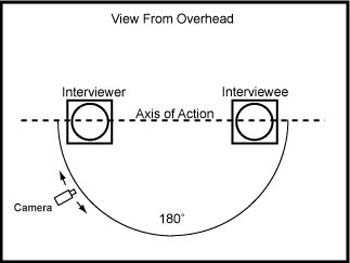
The 180 Degree rule is the most important part when filming dialogue. It acts with the shot/reverse shot and helps the continuity of the shot. The 180 Degree rule means that when you shot one character and they are positioned on the left of the screen, your reverse shot needs to be the same. This means that the other character in the reverse shot needs to be on the left of the screen as well. This makes it seem as if the two characters are opposite each other rather than next to each other. While filming the 180 Degree Rule, you need to have an imaginary line on the floor in which you cannot cross, this is known as the axis of action. If you cross this, you brake the rule. This diagram should help understanding:
Thursday, 30 October 2014
Prelimary Task- Final piece
This is my final piece from my prelimary task. We used lots of editing skills to make this film continuous, however at 0.13 it was not the best. You could see the visible editing where it should have been invisible. If we took a little more care in our camera positioning I think it would have made it more continuous. For a first attempt of editing together film clips, I think this went fairly well.
To see this piece, click here:
To see this piece, click here:
Friday, 24 October 2014
Preliminary Task
In the previous lesson, we were given a preliminary task to complete, which was:
 Two following posts will be uploaded, linking to this, to explain Match on Action and the 180 Degree Rule.
"Continuity task involving filming and editing a character opening a door, crossing a room, sitting down in a chair opposite another character, with whom she/he then exchanges a couple of lines of dialogue. This task should demonstrate: match on action, shot/reverse shot and the 180 degree rule."Before anything, we had to plan. So this is the storyboard my group will be following:
Friday, 17 October 2014
Editing
In a lesson, we have focused on editing. We have been given lots of key terms to learn to show our understanding of the editing process.
Cut: The most basic and common type of transition is the cut. It is mainly used when one shot replaces another, instantly. The main reason for a cut is to make sure the film runs smoothly while the audience still understands and interprets the scene correctly. Cut is also essential for Juxtaposition (two things being seen or placed close together with contrasting effect.)
Main uses involve:
Cut: The most basic and common type of transition is the cut. It is mainly used when one shot replaces another, instantly. The main reason for a cut is to make sure the film runs smoothly while the audience still understands and interprets the scene correctly. Cut is also essential for Juxtaposition (two things being seen or placed close together with contrasting effect.)
Main uses involve:
- Change scene
- Compress time
- Vary the point of view
- Montage, build up on image/idea
Match Cut: The match cut is the basis for continuity editing. Editors use this cut to suggest a relationship between two different objects or to create a 'visual metaphor'.It can be two different objects, different spaces or two different compsoitions that graphically match.
Main uses involve:
- Continuity of direction
- Completed action
- A similar centre of attention in the frame
- A one-step change of shot size (long to medium)
- A change in angle
Jump Cut: The jump cut is a type of cut that includes two sequential shots of the same object but the camera arrangement only varies slightly. This cut gives the impression of going forward in time.
Motivated Cut: The motivated cut is used to connect two scenes: the subject searching for something of interest and the object of interest. It is often used to show the two objects far apart.
Cutting Rate: The cutting rate of a film included how many cuts are used within a certain amount of time. For example, you will find that action scenes have a higher cutting rate than romance films because there is more action to match the rate with.
Cutting Rhythm: The cutting rhythm is used to create a sense. For example the rythm may be slowed down to create tension and drama.
Cross Cut: The cross cut is often used to show action in more than one location. The camera will cut away from one scene of action to the other, sometimes suggesting simultaneity.
Cutaway: A cutaway is an interuption of continuous camera action, by a view of something else. It usually is followed by a cut back to the first shot.
Reaction Shot: The reaction shot is a shot used to cut away from the main scene to show a reaction of the characters involved.
Fade/Dissolve: The fade transition is a gradual fade from the main picture, normally to either a black screen or a solid colour. The dissolve transition is when one picture is gradually overlapping the other picture.
Friday, 10 October 2014
Sound Research, war soundtrack
In a lesson, working in partners, we had to proudce a short soundtrack representing World War 1. Me and my partner, Amy, created some of our own sounds and used sounds off of SoundBible to recreate the scene. We then edited our audio on MovieXPlus 6 to make it flow. Creating our own sound (Foley Sound) was difficult as it was hard to create an exact sound, however, it was interesting what objects could make such hard sounds! We recreated the start of the track by standing in muddy water and gravel in welly boots to act out walking in the trenches. The grenade fading and stormy weather helped realise the environment at war. Dialogue was also used to show pain and emotion within soldiers.
The final piece is on Amy's blog as I could not upload due to technical problems with MovieXPlus.
This is the link to our final piece:
http://amysimpsonmediastudies.blogspot.co.uk/2014/10/war-soundtrack.html
The final piece is on Amy's blog as I could not upload due to technical problems with MovieXPlus.
This is the link to our final piece:
http://amysimpsonmediastudies.blogspot.co.uk/2014/10/war-soundtrack.html
Subscribe to:
Posts (Atom)